
Patient Engagement Solutions for Hospitals: Custom Software to Accelerate Value-Based Care
Transitioning from fee-for-service toward value-based care is a top priority for healthcare organizations, insurance companies, and accountable care organizations (ACOs). Yet, achieving the goals of improved outcomes, lower costs, and high patient satisfaction demands more than contracts and incentives — it requires meaningful patient engagement. Digital patient engagement solutions for hospitals play a critical role in this transformation.
Patient engagement software, when well designed and integrated, empowers patients, reduces avoidable utilization, and aligns with value-based care metrics. In this article, we explore why and how top managers in hospitals, payers, and health systems should invest in patient engagement applications, the evidence behind them, and how custom development can deliver tailored, scalable tools that drive measurable value.
Benefits of Patient Engagement Solutions for Hospitals
When hospitals, payers, and ACOs look for ways to move toward value-based care, they often start with care coordination, reimbursement models, and staffing changes. Yet real progress usually happens when patients take an active role in their care. This is where patient engagement solutions for hospitals bring measurable value.
The right mix of healthcare patient engagement solutions, patient engagement software, and a structured engagement approach can help patients understand what is happening with their health, follow their treatment plans, and stay connected with their care team. With better engagement, hospitals often see fewer preventable readmissions, more timely follow ups and clearer communication across teams.
Below are some practical benefits that healthcare leaders usually see when they adopt custom patient engagement applications and digital patient engagement platforms.
Better Support for Chronic Care
Patients living with conditions like diabetes, hypertension, and heart failure often need daily guidance. A custom patient engagement application can simplify this process by sending clear instructions, short reminders, and educational content at the right time. As a result, patients are less likely to miss important steps in their treatment plan.
More Consistent Communication
Hospitals that use patient engagement platforms allow patients to ask questions, report symptoms, and request support without waiting for their next appointment. This type of secure communication closes gaps that often lead to complications and costly visits.
Fewer Avoidable Readmissions
Engaged patients are more likely to follow discharge instructions, monitor their symptoms, and reach out early when they feel unwell. This reduces avoidable readmissions, which is one of the main goals in value-based contracts.
Higher Patient Satisfaction
A simple and supportive digital experience often makes patients feel understood. Better communication, real-time guidance, and easy access to information help patients feel more confident, which usually raises their satisfaction scores.
Reduced Administrative Load
With automated reminders, pre-visit forms, digital check-ins, and remote symptom tracking, care teams spend less time on manual outreach. This helps nurses and coordinators focus on the patients who need them the most.
Key Components of Effective Patient Engagement Solutions
Effective patient engagement solutions for hospitals go far beyond appointment reminders or basic portals. They support patients daily, guide them through their specific care journeys, and help care teams track progress in real time. The components below reflect what hospitals, payers, and ACOs usually need when moving toward value-based care. They follow the structure and emphasis found in the first draft but written with a clearer, more conversational flow.
Remote Monitoring and Telehealth Support
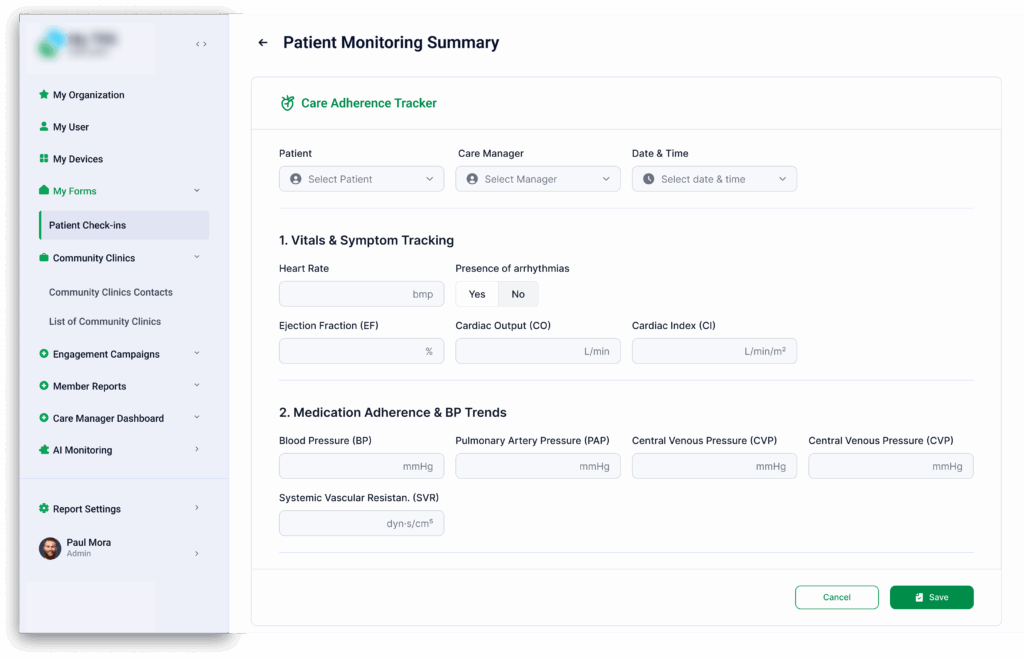
Remote monitoring helps hospitals and payers check on patients without requiring in-person visits. When monitoring devices send data directly into patient engagement software, care teams can identify early changes and reach out before a condition becomes serious.
Connecting these devices with telehealth makes follow-up smoother. Patients can talk to a clinician, share symptoms, or upload readings through patient engagement apps, which reduces unnecessary visits and supports value-based care goals.
Read about our service: Remote Patient Monitoring Software for Value-Based Care
Education and Self-Management Tools
Patients need clear guidance, not long documents full of medical terms. Custom patient engagement applications allow hospitals to give patients step-by-step instructions for recovery, chronic care, or pre-surgery preparation.
Short videos, checklists, reminders, and simple explanations help patients understand what to do, when to do it, and why it matters. When patients follow these instructions, they are more likely to stay on track and avoid complications.
Secure Messaging and Two-Way Communication
A strong digital patient engagement platform makes communication easy for both patients and clinicians. Patients can ask questions, confirm instructions, report symptoms, or share concerns without waiting for their next appointment.
This reduces stress for patients, improves clarity, and helps clinicians catch problems earlier. It also supports smoother handoffs across care teams.
Workflow Automation
Hospitals spend a lot of time sending reminders, collecting patient forms, and reaching out manually. Custom healthcare patient engagement solutions can automate many of these steps.
Examples include:
- appointment reminders
- medication reminders
- digital pre-visit forms
- follow-up check-ins
Automation reduces administrative workload and frees care teams to focus on direct patient care.
Alerts and Prioritization
A strong engagement system should highlight the patients who need help right now. Custom patient engagement platforms can show which patients have abnormal readings, concerning symptoms, or missed steps in their care plan.
This helps clinicians prioritize their time and prevents them from being overwhelmed by unnecessary notifications.
Data Analytics and Progress Tracking
Value-based care depends on measurable improvements. Custom patient engagement solutions can track patterns in patient behavior, symptom trends, and engagement levels over time.
Hospitals and payers use these insights to adjust care pathways, identify risk, and improve outcomes.
Read about our service: Custom Value Based Care Analytics Platform
Interoperability and Security
Hospitals and payers cannot afford data silos. Effective digital patient engagement platforms connect smoothly with EHRs, care management tools, and analytics systems.
This avoids duplicate entries and helps clinicians make informed decisions.
Strong security, encrypted communication, and role-based permissions protect patient data and keep the organization compliant with regulations.
5 Challenges and Solutions When Implementing Patient Engagement Systems
Even strong hospitals and payers face challenges when implementing engagement tools. Below are the most common challenges and practical solutions that custom development can support.
Challenge 1: Patients Do Not Use the System
Patients may forget passwords, lose interest, or avoid technology.
Solution: Build simple login flows, offer support for low-tech users, allow SMS based communication, and keep instructions clear.
Challenge 2: Clinician Alert Fatigue
Too many alerts frustrate care teams.
Solution: Use intelligent thresholds, tiered alerts, and a clear escalation system. Custom systems allow you to adjust these settings based on real-world results.
Challenge 3: Integration Issues With Existing Systems
Many hospitals run older systems that do not communicate well with new tools.
Solution: Build custom connectors, use modern standards like FHIR, and allow staged integration during the discovery and development phases.
Challenge 4: Privacy and Regulatory Requirements
Handling health data requires strict compliance standards.
Solution: Custom solutions allow full control over security practices, access management and auditing.
Challenge 5: Staff Resistance to New Workflows
Teams often fear that new software will increase workload.
Solution: Involve clinical staff early in the discovery phase, test workflows before full rollout, and adjust features based on real feedback.
Why Sigma Software is the Right Partner
Hospitals, payers, and ACOs need partners who understand technology and also understand the real needs of value-based care. Our team builds custom patient engagement solutions for hospitals with a focus on simple design, strong integration, and practical outcomes.
We Start With a Discovery Phase
This phase helps us understand your patient population, your care pathways, your value-based contracts, your reporting needs, and your current digital infrastructure. We speak with your clinical teams, operational leaders, and IT staff to make sure we design the right solution from the start.
We Follow Outcome-Based Delivery
Our goal is not to build software for the sake of software. We focus on delivering outcomes that matter to your organization, such as reduced readmissions, improved patient communication, or better chronic care management. Each milestone we deliver is measured against these outcomes.
We Have Strong Domain Expertise
Our team has long-term experience creating patient engagement applications, digital patient engagement platforms, remote monitoring systems, and healthcare analytics tools. This helps us understand your operational environment and build features that match your workflow instead of forcing you to change it.
We Build for Long-Term Value
As your organization grows, new care pathways, new devices, and new reporting needs will appear. Our team builds flexible solutions that can expand with you with minimal disruption.
We Support You Through Implementation
We help with staff onboarding, system integration, pilot programs, training, and feedback cycles. Our goal is to make the transition smooth for both your care teams and your patients.
Final thoughts
For healthcare leaders and top managers in insurance companies, ACOs, and hospitals, the shift to value-based care is not just about contracts — it is about putting patients at the center. Patient engagement solutions for hospitals, particularly when combined with remote patient monitoring, are a proven way to boost adherence, reduce readmissions, and improve outcomes.
Custom software development ensures that the solution is not a one-size-fits-all tool but a strategic asset aligned with your risk models, care pathways, and organizational goals. By following a clear implementation roadmap — from pilot to scale — you can realize both clinical and financial value.
If you want to explore a tailored, digital patient engagement platform that fits your value-based care strategy, we are ready to help you build it, grow it, and measure its impact.
Want to see what this looks like in practice? Let’s talk.
Patient engagement solutions are digital tools — such as apps, portals, and remote monitoring systems — that enable patients to actively participate in their care. They are critical in value-based care because engaged patients tend to adhere better to treatment, self-manage chronic conditions, communicate early about issues, and avoid unnecessary readmissions, all of which support value-based performance metrics.
Key features include remote monitoring integration, secure messaging, patient education modules, workflow automation (reminders, scheduling), predictive analytics for risk stratification, and interoperability with EHRs.
Yes. Research shows RPM combined with engagement tools helps detect early signs of deterioration, enabling proactive interventions, which can significantly reduce readmissions.
Custom development allows for tailored solutions aligned with your specific patient population, risk models, reimbursement structure, and existing technology stack. This leads to better adoption, integration, and long-term ROI compared to one-size-fits-all off-the-shelf products.
Costs vary depending on the complexity, scale, and integrations needed. However, the investment can be justified by long-term savings (fewer readmissions, better resource utilization) and potential additional revenue from reimbursable services.
Ready to Solve Your Value-Based Care Challenge?
Let’s talk about your unique workflows and design a custom digital health solution that supports outcome-based care, improves population health, and aligns with value-based reimbursement models.
Whether you’re navigating HEDIS metrics, improving care coordination, or optimizing performance-based contracts, we can help.
Build Your Custom Implementation Plan
Your implementation plan includes integrations, MVP timelines, and long-term support strategies. We build your value-based care solution around real workflows, compliance requirements, and measurable outcome goals.
Launch and Optimize for Outcome-Based Development
Our solutions combine predictive analytics, AI-driven clinical insights, and secure, interoperable data flows. Whether you need compliance tools, shared savings tracking, or a care coordination engine, we align it with your quality metrics, reimbursement goals, and care delivery model.
Ready to Improve Outcomes with Custom Value-Based Solutions?
We design and build custom software for value-based healthcare, built around your data, workflows, and objectives. Whether you need to unify data, support attribution, or track performance across contracts—we’re here to build what works.
Custom Software for Aesthetic Clinics: Overcoming Digital Growth Challenges
Solving the 5 Core Data Infrastructure Problems in Diagnostics
3 AI Execution Gaps Slowing Down Medical Distribution
Resolving Fragmented Clinical Data in Biotech
The 7 Core IT Engineering Bottlenecks in Clinical Stage Biotech (And How to Resolve Them)
Where AI Actually Works in Biotech: Clinical Trials, Genomics, and Drug Discovery
Stay in the loop with everything you need to know.