
Preparing for the CMS TEAM Model: Practical steps for payers and hospitals
Starting January 1, 2026, the Centers for Medicare & Medicaid Services (CMS) will launch the Transforming Episode Accountability Model (TEAM). This mandatory initiative requires selected hospitals to manage both cost and quality outcomes for patients undergoing specific surgical procedures. It marks a major shift toward value based care in US healthcare, aiming to improve coordination between surgery and recovery, reduce complications, and control costs.
This article explores how TEAM fits into the broader value based healthcare model, what it requires from payers and providers, and how custom software development, including remote monitoring and analytics, can make implementation smoother and more effective.
The Shift Toward Value-Based Care in the U.S.
For years, the American healthcare system has moved steadily away from volume-based reimbursement toward models that reward results. Rising costs and uneven outcomes have made it clear: delivering more services doesn’t necessarily mean delivering better care.
That’s why value based care companies now focus on efficiency, coordination, and measurable outcomes instead of service volume.
What is a value based care model in healthcare?
A value based care model in healthcare rewards providers for keeping patients healthier, preventing complications, and coordinating care across the continuum. Payment is tied to measurable outcomes—such as reduced readmissions or improved patient-reported recovery—instead of each visit or test.
Why this matters for payers and providers
For payers, ACOs, and hospitals, this shift means:
- Tracking detailed value based care metrics like readmission rates and post-acute utilization.
- Redesigning care pathways with providers and deploying digital tools that monitor progress.
- Investing in interoperability, analytics, and remote patient engagement.
The value based care benefits are tangible: fewer complications, lower costs, higher satisfaction, and better payer–provider alignment.
Read about Why Value-Based Care Matters to Payers — Software-First Roadmap to 2030

The TEAM Model: What It Is and Why It Matters
Introduction to TEAM
The Transforming Episode Accountability Model (TEAM) is CMS’s next major step in expanding mandatory value-based payment models. Announced in 2024, it replaces or complements previous voluntary programs like BPCI Advanced and CJR.
TEAM will apply to around 700 hospitals in selected metropolitan areas (Core-Based Statistical Areas). It covers five high-cost surgical episodes:
- Lower extremity joint replacement (LEJR)
- Surgical hip/femur fracture treatment (SHFFT)
- Spinal fusion
- Coronary artery bypass grafting (CABG)
- Major bowel procedures
Each episode begins at admission (inpatient or outpatient) and continues 30 days post-discharge.
Hospitals will still bill Medicare fee-for-service, but CMS will later reconcile actual episode costs against a target price. If hospitals stay below the target and meet quality thresholds, they share in savings. If they exceed targets or miss quality marks, they owe repayments.
This makes TEAM part of the types of value based care models known as bundled payments, where a single price covers the entire care episode.
Why TEAM Matters for Payers and Providers
TEAM is mandatory for selected hospitals, signaling CMS’s confidence in value-based methods.
For executives, this means three things:
- Financial accountability for surgical outcomes is unavoidable.
- Coordination across surgery, post-acute care, and recovery is now a must.
- Data transparency between payers and providers is key to managing risk.
It also creates new opportunities:
- Payers and ACOs can collaborate with hospitals to align data and incentives.
- Hospitals can use TEAM to standardize care, reduce variation, and improve performance.
- Patients can expect smoother recovery and more personalized support.
Preparing for TEAM: A Step-by-Step Roadmap
1. Assess Baseline Metrics
Start by analyzing your surgical episodes. Review spending, post-acute utilization, readmissions, and patient-reported outcomes. This baseline is essential for tracking value based care metrics later.
Ask:
- Are current IT systems capturing PROMs and referral data?
- Can you connect inpatient, outpatient, and post-acute datasets?
- How do your current results compare to national benchmarks on CMS.gov?
2. Redesign Clinical and Operational Pathways
Standardize care from pre-op optimization to post-discharge monitoring.
- Create checklists for discharge planning.
- Require primary care referrals before discharge (a CMS requirement).
- Establish clear post-acute coordination and follow-up workflows.
3. Strengthen Payer–Provider Collaboration
For payers and ACOs, TEAM success depends on collaboration.
- Build shared dashboards showing cost and quality trends.
- Develop gain-sharing contracts that mirror TEAM incentives.
- Align care management teams to reduce duplication and improve follow-up.
Read about our service: Remote Patient Monitoring Software for Value-Based Care
4. Modernize Your Technology Stack
This is where custom software development plays a central role.
Off-the-shelf tools rarely fit every network’s structure, and many legacy EHRs cannot meet CMS reporting requirements.
Custom-built value based care solution software can integrate:
- Episode tracking from surgery through recovery.
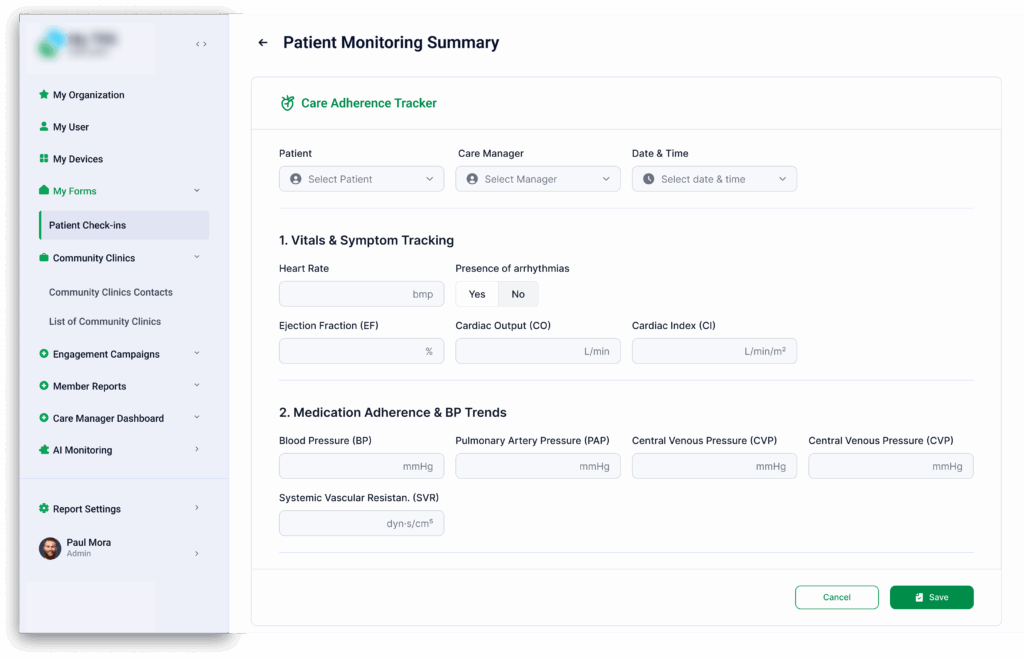
- Remote monitoring tools for post-acute patients.
- Analytics dashboards with real-time episode costs and quality performance.
- Interoperability connectors for claims, EHR, and home-monitoring data.
This approach lets executives monitor TEAM readiness and act before reconciliation.
How Custom Software Development Enables TEAM Success
Unified Care Coordination
A custom platform connects hospitals, surgeons, primary care, and post-acute providers in one interface. It manages hand-offs, triggers alerts, and tracks every step of the patient’s episode.
Real-Time Analytics
Dashboards track cost vs. target, readmission rates, and PROMs capture key value based care quality measures. Executives can visualize performance instantly and identify risks before CMS reconciliation.

Read about our service: Custom Value Based Care Analytics Platform
Remote Patient Monitoring
Post-discharge remote monitoring allows care teams to detect complications early. For example, wound-healing photos, symptom logs, and virtual check-ins can reduce readmissions, directly improving your value based care metrics.
Integration and Compliance
Custom solutions ensure data flows smoothly between EHR, claims, and CMS reporting systems. They’re HIPAA-compliant, interoperable, and built to scale across types of value based care models.
Scalability Beyond TEAM
Once built, your platform can support additional bundled payments and broader value based healthcare model initiatives. TEAM readiness today becomes a long-term advantage tomorrow.
Why Sigma Software Is the Right Partner for TEAM Success
At this stage, the question isn’t if you need technology to succeed under TEAM — it’s who can build the right one for your unique workflows. That’s where Sigma Software comes in.
Our Domain Expertise
Sigma Software has partnered with multiple value based care companies, payers, and hospital systems across the US and Europe. Our team understands the realities of value based care in us healthcare, including CMS reporting, post-acute coordination, and the analytics needed to measure improvement.
We don’t just build software; we design value based care solution platforms that drive measurable results.
Our Discovery Phase
Every partnership begins with a detailed discovery phase. We work directly with your executives, clinicians, and data teams to identify pain points, define workflows, and align technology with your strategic goals.
The outcome is a clear roadmap that defines scope, success metrics, and expected ROI — ensuring the final product delivers business value, not just code.
Outcome-Based Delivery
Our delivery model focuses on outcomes, not just milestones. Whether we’re building a remote patient monitoring app, an interoperability hub, or a care coordination dashboard, success is measured by the same metrics CMS will use: improved outcomes, lower cost, and streamlined reporting.
This aligns perfectly with the value based healthcare model principles that TEAM promotes.
Core Services for TEAM Readiness
- Custom analytics dashboards to visualize episode costs, trends, and value based care metrics in real time.
- EHR and claims integration to create unified patient and cost views across systems.
- Remote monitoring platforms for post-discharge engagement, PROMs collection, and early risk alerts.
- Regulatory reporting tools aligned with CMS templates for reconciliation and quality submissions.
How We Work
We combine healthcare expertise, modern technologies, and agile delivery methods. Our engineers and data specialists ensure every solution integrates seamlessly with your existing systems and scales as your value-based programs expand.
Results That Matter
Working with Sigma Software means partnering with a team that’s already helping providers and payers succeed in value based care in US healthcare. We make complex transitions practical, measurable, and sustainable.
Ready to Prepare for TEAM? Let’s Talk.
The 2026 start date may seem far away, but preparing for the CMS TEAM model requires months of planning, system design, and integration.
Whether you’re a hospital, payer, or ACO, now is the time to start.
Sigma Software can help you build a custom value based care solution that meets TEAM’s requirements — from remote monitoring and analytics to full care coordination systems.
TEAM begins January 1, 2026, and runs through 2030 for the initial five-year design. It is mandatory for acute care hospitals in the selected Core Based Statistical Areas that CMS has listed.
TEAM includes lower extremity joint replacement, surgical hip and femur fracture treatment, spinal fusion, coronary artery bypass graft, and major bowel procedures.
The episode begins with the inpatient admission or outpatient procedure and ends 30 days after discharge.
CMS compares actual episode spending and quality performance to target prices. If spending is below target and quality is met, the hospital can share in savings. If spending exceeds the target or the quality does not meet the thresholds, hospitals may owe repayments.
Yes. Technology that tracks episodes, collects PROMs, integrates claims and EHR data, and supports remote patient monitoring makes it feasible to manage cost and quality across the 30-day window.
Ready to Solve Your Value-Based Care Challenge?
Let’s talk about your unique workflows and design a custom digital health solution that supports outcome-based care, improves population health, and aligns with value-based reimbursement models.
Whether you’re navigating HEDIS metrics, improving care coordination, or optimizing performance-based contracts, we can help.
Build Your Custom Implementation Plan
Your implementation plan includes integrations, MVP timelines, and long-term support strategies. We build your value-based care solution around real workflows, compliance requirements, and measurable outcome goals.
Launch and Optimize for Outcome-Based Development
Our solutions combine predictive analytics, AI-driven clinical insights, and secure, interoperable data flows. Whether you need compliance tools, shared savings tracking, or a care coordination engine, we align it with your quality metrics, reimbursement goals, and care delivery model.
Ready to Improve Outcomes with Custom Value-Based Solutions?
We design and build custom software for value-based healthcare, built around your data, workflows, and objectives. Whether you need to unify data, support attribution, or track performance across contracts—we’re here to build what works.
Custom Software for Aesthetic Clinics: Overcoming Digital Growth Challenges
Solving the 5 Core Data Infrastructure Problems in Diagnostics
3 AI Execution Gaps Slowing Down Medical Distribution
Resolving Fragmented Clinical Data in Biotech
The 7 Core IT Engineering Bottlenecks in Clinical Stage Biotech (And How to Resolve Them)
Where AI Actually Works in Biotech: Clinical Trials, Genomics, and Drug Discovery
Stay in the loop with everything you need to know.