
Healthcare Software Development Services
Sigma Software delivers medical software development services and healthcare software development through custom healthcare solutions designed for healthcare organizations that need seamless integration, operational efficiency, and compliance-ready platforms across care delivery, analytics, and claims management.
What Kind of Problems Sigma Software Solves for Healthcare Providers?
We address the operational, technical, and regulatory challenges that prevent healthcare organizations from delivering efficient, patient-centered care.
Slow prior authorisations & manual workflows
Automated workflows and system integration accelerate approvals, reduce claim denials, and free staff to focus on patient care.
Poor data quality across clinical & claims systems
Structured pipelines, standardized models, and validation ensure accurate reporting, better analytics, and informed decision-making.
EHRs overloaded with operational tasks
Companion apps and targeted healthcare software development offload non-clinical work while keeping patient records centralized and reliable.
Outdated legacy systems blocking innovation
Safe modernization of existing platforms enables new features, improves performance, and supports innovation without disrupting care.
Complex integrations with payers, labs, and devices
Secure APIs, FHIR/HL7/X12 mapping, and structured workflows connect systems seamlessly, improving interoperability and data flow.
What Healthcare Solutions Does Sigma Software Deliver?
Care Coordination Tools
We build clinician- and care-team-facing applications that connect to EHRs, manage tasks, track care plans, and support secure messaging. Our custom healthcare software development solutions reduce administrative overhead, enabling care teams to focus on patient outcomes.
Results: Faster care transitions, fewer task escalations, improved follow-up adherence.

AI & Data Insights
We integrate AI and advanced analytics into healthcare software to provide predictive insights, optimise care pathways, and support data-driven decisions. Our custom healthcare software development solutions enable smarter population health management, risk stratification, and operational efficiency.
Results: Improved decision-making, earlier intervention opportunities, and more accurate risk adjustment.
Prior Authorisation Automation
Our software development services for healthcare automate workflows for extraction, validation, and submission between providers and payers. UI-driven authorisation and rules engines reduce manual work and errors.
Results: Shorter approval cycles, lower administrative costs, fewer claim denials.


Claims Processing Software
We develop modular claims pipelines, adjudication services, and reconciliation tools. PHI is separated from analytics, tokenisation is applied, and auditable trails are maintained.
Results: Faster claims throughput, reduced rework, and reliable payment cycles.
Patient Engagement Solutions
Our healthcare software developers build patient portals, appointment systems, telehealth integrations, and outreach platforms. Identity, consent, and CRM integration ensure secure, seamless interactions.
Results: Higher portal adoption, better patient satisfaction, improved care plan adherence.


Governed Data & Analytics
We embed healthcare data governance and compliance rules into applications: canonical data models, lineage tracking, and validation gates. This makes analytics reliable and audit-ready.
Results: More accurate risk adjustment, defensible quality measures, faster analytics cycles.
Legacy Modernisation & Incremental Migration
As a healthcare software development agency, we modernise legacy systems using API layers, strangler patterns, and phased rollouts. Operational continuity is preserved throughout.
Results: Reduced migration risk, incremental ROI, uninterrupted clinical operations.

How This Works in Practice
See how we have delivered similar solutions for healthcare organizations, from initial concept to production systems with measurable results.
Our Unique Methodology to Building Healthcare Software
Our Approach:
Discovery
Map PHI/PII, system integrations, and clinical workflows to identify risks and opportunities.
Architecture & Roadmap
Design scalable systems, security models, and a phased delivery plan.
Product Engineering
Develop in iterative sprints with user validation, testing, and continuous security checks
Integrations & Launch
Connect EHRs, partner systems, and external data sources for smooth deployment.
Support & Upgrades
Monitor performance, maintain systems, and manage backlog for continuous improvement.
Why Healthcare Providers Choose Sigma Software
Understand healthcare operations and workflows
Deliver custom healthcare software development solutions aligned with real needs
Integrate seamlessly with existing platforms
Provide a trusted hospital software development company experience
Why Sigma

FAQ
We build custom healthcare software development solutions tailored to your workflows and integrate with existing systems.
Yes. Our healthcare software developers ensure secure, compliant integrations.
Security, logging, and access controls are embedded in all systems, and we coordinate with your compliance teams.
Ready to Build Your Custom Healthcare Software?
Let’s talk about your unique workflows and design a custom digital health solution that supports outcome-based care, improves population health, and aligns with value-based reimbursement models.
Whether you’re navigating HEDIS metrics, improving care coordination, or optimizing performance-based contracts, we can help.
Request Free contact to discuss solution
or you can book a call right now
Build Your Custom Implementation Plan
Your implementation plan includes integrations, MVP timelines, and long-term support strategies. We build your value-based care solution around real workflows, compliance requirements, and measurable outcome goals.
Launch and Optimize for Outcome-Based Development
Our solutions combine predictive analytics, AI-driven clinical insights, and secure, interoperable data flows. Whether you need compliance tools, shared savings tracking, or a care coordination engine, we align it with your quality metrics, reimbursement goals, and care delivery model.
Ready to Improve Outcomes with Custom Value-Based Solutions?
We build custom software for value-based healthcare, tailored to your data, workflows, and objectives. As one of the healthcare software development companies focused on complex healthcare environments, we help you unify data, support attribution, and track performance across contracts by building solutions that work in practice.
You could be interested
We have collected more interesting posts with same topics for you
Custom Software for Aesthetic Clinics: Overcoming Digital Growth Challenges
Solving the 5 Core Data Infrastructure Problems in Diagnostics
3 AI Execution Gaps Slowing Down Medical Distribution
Resolving Fragmented Clinical Data in Biotech
The 7 Core IT Engineering Bottlenecks in Clinical Stage Biotech (And How to Resolve Them)
Where AI Actually Works in Biotech: Clinical Trials, Genomics, and Drug Discovery
Donor Evaluation & Viability Platform for Organ Transplant Programs
A transplant coordination center partnered with our team to develop a custom transplant software solution tailored to the high-stakes environment of organ donation and allocation.
The result: a centralized Donor Evaluation & Viability Platform that improves the accuracy, safety, and speed of pre-donation donor assessments.
Unlike off-the-shelf transplant workflow automation tools, this platform was built from scratch around the center’s specific clinical criteria, organizational structure, and regulatory needs. It now serves as a real-time, shared system for donor viability analysis, powering confident decisions with AI-based scoring, structured vitals capture, and collaborative access for all transplant stakeholders.
Objective: Improve Donor Assessment & Organ Suitability Decisions
For transplant teams, every second counts, and every data point matters. But before a transplant happens, donor evaluation is one of the most critical, risk-prone steps in the process.
Our client needed to eliminate friction, reduce missed signals, and replace siloed decision-making with a streamlined, clinical decision support system for organ transplantation.
Their core challenges:
- Unstandardized donor data across clinicians, shifts, and sites
- Delayed decision cycles due to scattered spreadsheets, lab systems, and EMRs
- High variability in clinical judgment, especially for marginal donors
- Lack of audit trails and quality review mechanisms
- Their goal was to implement a pre-donation transplant tool that would support fast and confident decisions, reduce medical risks, and simplify coordination between OPOs, ICU teams, and transplant centers.
What We Delivered: A Custom Donor Evaluation & Viability Platform
We worked closely with transplant coordinators, clinicians, and IT stakeholders to design and develop a donor risk scoring platform that brings structure, insight, and collaboration to donor evaluation.
The developed donor evaluation platform for OPOs and transplant teams enables:
- Real-time vitals and lab data capture via structured smart forms
- Clinical decision support via built-in scoring models
- Unified access for transplant surgeons, ICU physicians, and OPO staff
- AI tools for early detection of metabolic and cardiovascular risks
- Role-based access with modular workflow views
- Seamless data handoff to transport and recipient teams
Interface Overview: Designed Around Real Clinical Needs
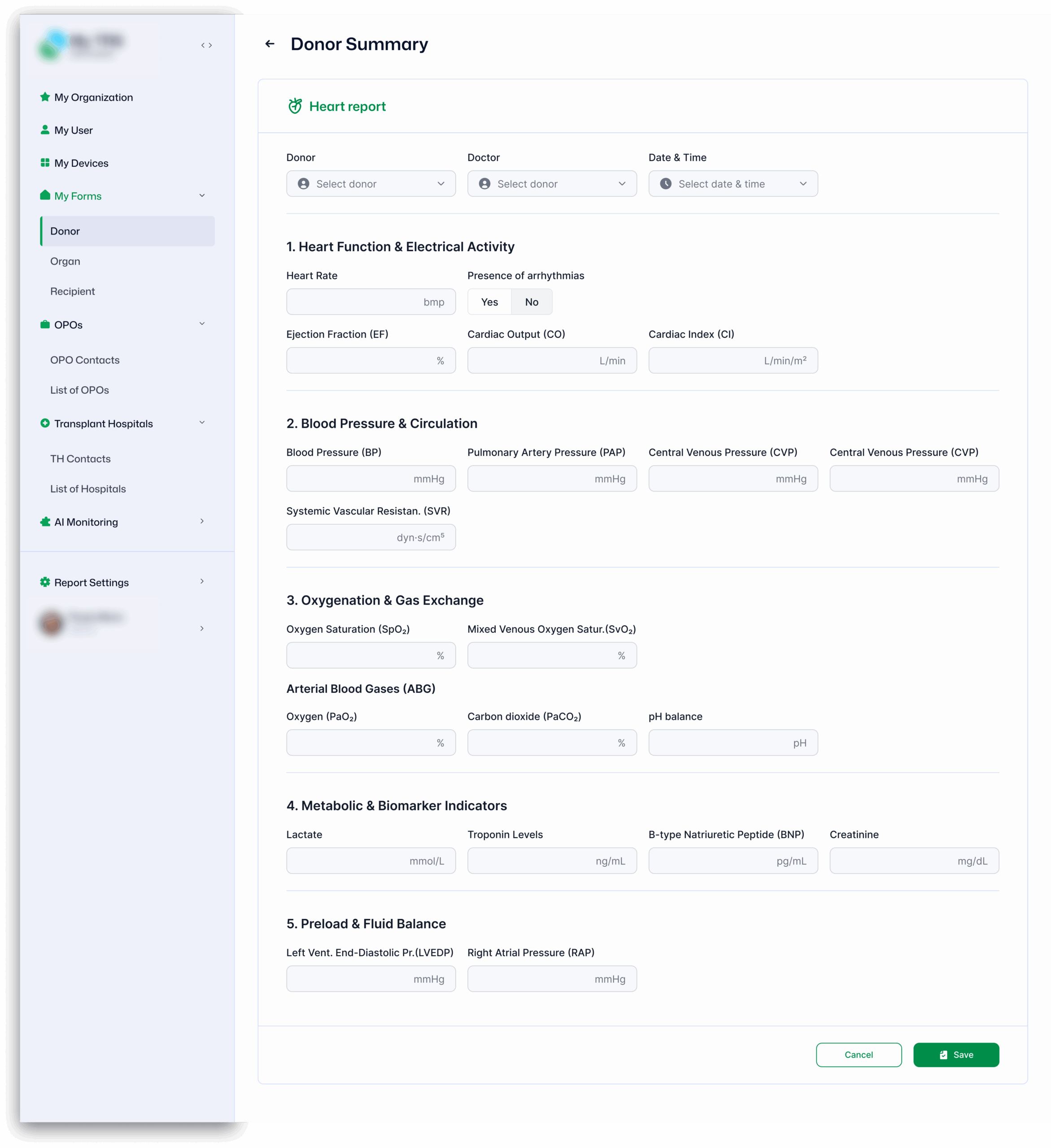
The Donor Evaluation & Viability Platform wasn’t built as a general interface, it was architected around the exact decision-making steps transplant teams follow during the donor screening stage. Each section was developed in direct response to the clinic’s core challenges:
1. Donor Summary Header

Problem: No centralized record of who entered data or when
What We Built: A header bar with fields for Donor ID, Doctor, and Time Stamp
Why It Matters: Supports audit trails, longitudinal data tracking, and accountability in time-sensitive scenarios
2. Heart Function & Electrical Activity Section

Problem: Fragmented cardiac data made it difficult to determine if the heart was viable
What We Built: Structured input for Ejection Fraction, Cardiac Output, Arrhythmia presence, and other key markers
Why It Matters: Empowers surgeons to make fast decisions based on real-time cardiac performance and rhythm stability
3. Circulation & Pressure Metrics

Problem: Missing PAP/CVP readings often caused incomplete evaluations
What We Built: Fields for Pulmonary Artery Pressure, Central Venous Pressure, Systemic Vascular Resistance
Why It Matters: Provides a holistic view of blood flow and vascular tone—essential for multi-organ evaluation and donor stability
4. Gas Exchange & Respiratory Profile

Problem: Unstructured data on oxygen levels delayed lung decisions
What We Built: Input for ABG values (PaO₂, PaCO₂, pH), SpO₂, and SvO₂
Why It Matters: Offers instant insights into respiratory performance and metabolic compensation, critical for lung and heart transplant decisions
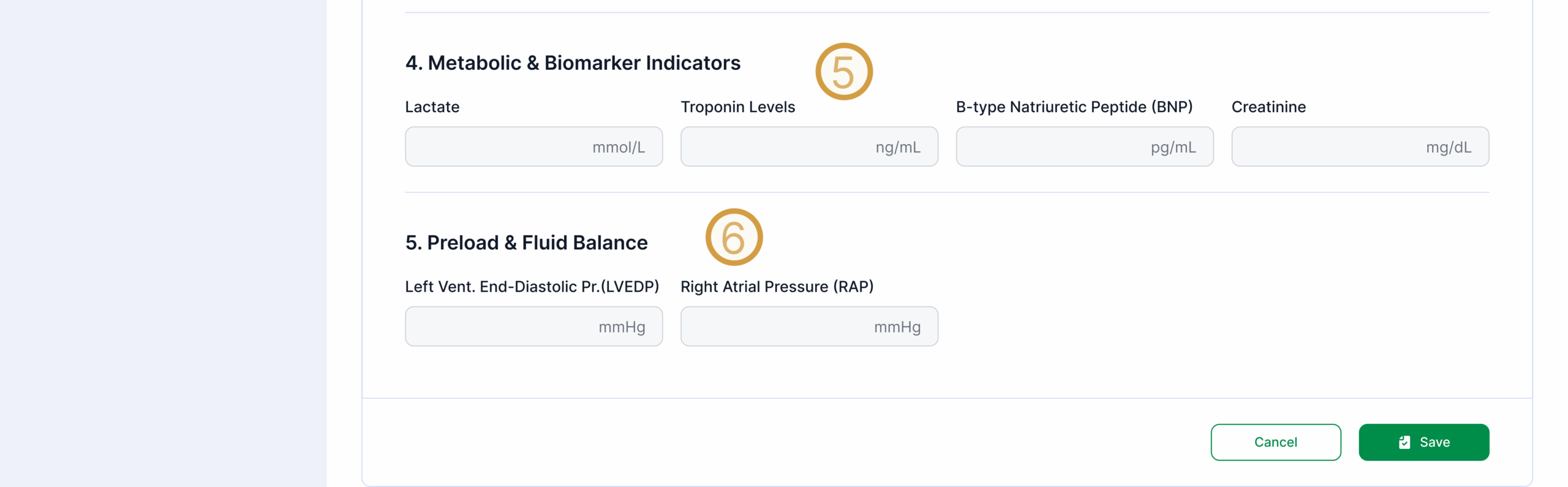
5. Biomarkers & Metabolic Stress Indicators
Problem: Elevated lactate or Troponin was often overlooked in spreadsheets
What We Built: Dedicated fields for Lactate, BNP, Troponin, and Creatinine
Why It Matters: Allows for AI-driven risk scoring and real-time alerts for ischemia, cardiac damage, or renal insufficiency
6. Preload & Volume Status
Problem: No consistent tracking of preload data across evaluations
What We Built: Input fields for LVEDP and RAP
Why It Matters: Helps transplant teams understand fluid status and predict heart transplant performance
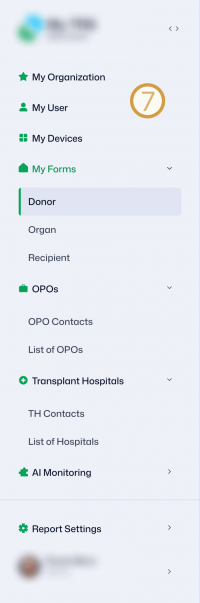
7. Sidebar Navigation
Problem: Clinicians were overwhelmed by irrelevant screens and forms
What We Built: A modular, collapsible menu with dedicated access to Donor, Organ, Recipient, Hospitals, OPOs, AI monitoring, and Reports
Why It Matters: Keeps clinicians focused on their domain, accelerates multi-role workflows, and prevents user fatigue
Key Features & Functional Value
Clinical Structuring Built from Medical Protocols
Every field and section in the Donor Evaluation & Viability Platform maps directly to real donor screening protocols. Unlike static spreadsheets or generic EMRs, this system ensures that no critical detail is missed, even under time pressure.
Intelligent Risk Assessment
The platform includes real-time organ viability scoring powered by early warning logic. For example:
- High lactate triggers an ischemia risk alert
- Elevated BNP/Troponin warns of cardiac injury
- Abnormal ABG readings suggest respiratory instability
- This turns raw data into clinical insight, giving the team an objective way to support difficult “accept or reject” decisions.
Single Platform, Multi-Stakeholder Ready
With role-based views and centralized data, the platform gives ICU teams, transplant surgeons, OPO staff, and logistics coordinators a shared workspace. Everyone works from the same, up-to-date evaluation.
Built for Expansion
Designed with modular architecture, the platform supports:
- Additional organ types (e.g., liver, pancreas)
- Custom viability scoring models
- Integration with lab systems, EHRs, and transport scheduling tools
Value Delivered
Increased Donor Safety
Clinicians can now flag high-risk organs faster, avoiding transplants that might fail or cause complications.
Standardized & Auditable Decisions
The structured format allows the clinic to review trends, defend decisions, and maintain compliance with national transplant standards.
Faster Evaluation Cycle
With all metrics in one place, real-time calculations, and alerts, the time from donor screening to organ allocation dropped significantly.
Improved Team Collaboration
By eliminating system silos, the platform became the central operating layer for transplant coordination, improving efficiency across every stakeholder group.