
Machine Learning and Computer Vision for Value-Based Care
Healthcare organizations and payers are under constant pressure to improve outcomes while controlling costs. In value-based care, success depends on accurately identifying at-risk patients, closing care gaps, and fairly attributing outcomes across teams and providers.
Machine learning and computer vision make this possible by providing precise risk scoring, advanced patient segmentation, and automated detection of care gaps. These technologies also support outcome attribution and shared savings calculations that drive contract performance.
As a custom healthcare software development company, we design and deliver custom healthcare software development services that integrate ML and CV into existing clinical and operational workflows. This enables organizations to move beyond retrospective reporting and use predictive and prescriptive insights to guide care delivery and financial decisions.
Purpose-Built Machine Learning and Computer Vision for Healthcare
Generic tools are not designed for the complexity of value-based care. By working with a healthcare software development company, organizations gain solutions purpose-built for their populations, data sources, and regulatory requirements.
Our custom healthcare software development solutions allow payers, ACOs, and providers to:
- Score patient risk with higher accuracy
- Detect care gaps automatically from structured and unstructured data
- Segment patient populations for targeted interventions
- Attribute outcomes fairly across providers and teams
- Measure vendor ROI using real-world patient data
Risk Stratification and Patient Segmentation
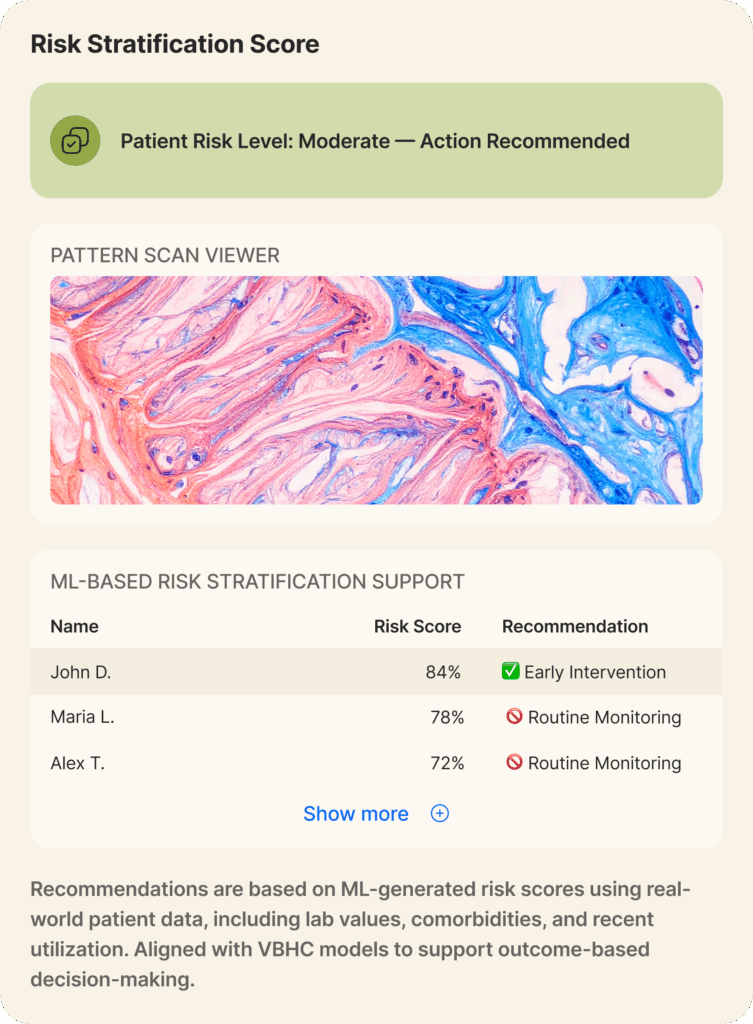
Risk stratification is central to value-based care. ML algorithms can rank patients by the likelihood of readmission, complication, or rising cost. Patient segmentation divides populations into actionable cohorts, enabling care managers to focus on those who benefit most from proactive outreach.
Technical Approach:
We develop models using structured claims and EHR data, combined with unstructured inputs such as clinical notes and imaging. Computer vision adds a layer by analyzing diagnostic images for disease progression or treatment response. Models are integrated into care management platforms with clear, interpretable outputs.
Use Cases:
- Identifying patients at high risk of hospitalization within 90 days
- Segmenting chronic disease populations (e.g., diabetes, COPD, CHF)
- Detecting early progression from imaging data with computer vision
- Prioritizing outreach lists for care managers
Care Gap Detection
Care gaps represent missed opportunities for preventive care and intervention. Detecting and closing these gaps improves both outcomes and contract performance.
Technical Approach:
ML models review claims, EHR, and scheduling data to flag overdue screenings, missed appointments, and lapses in treatment adherence. Computer vision supports this by automatically detecting evidence of untreated conditions in imaging or pathology slides.
Use Cases:
- Flagging patients overdue for cancer screenings
- Detecting treatment gaps in chronic disease pathways
- Identifying patients who dropped out of care programs
- Automating radiology review to reduce missed diagnoses
Program Performance and Outcome Attribution
Value-based contracts require accurate attribution of outcomes and savings to providers and teams. ML models ensure these calculations are fair, transparent, and based on real-world patient data.
Technical Approach:
We design attribution models that link interventions to outcomes, adjusting for patient risk and comorbidities. These models also compare outcomes before and after program implementation to assess vendor ROI. Results are presented in transparent dashboards for executives, financial teams, and care managers.
Use Cases:
- Allocating shared savings across provider networks
- Evaluating the effectiveness of chronic disease management programs
- Measuring ROI from third-party vendors
- Adjusting payment models based on real-world outcomes
Technical Approach — Data, Models, and Validation
Our ML and computer vision systems rely on diverse, high-quality healthcare data. We integrate multiple sources, normalize data using HL7 and FHIR standards, and validate models with both retrospective and prospective methods. This ensures predictions are clinically useful and financially defensible.
Data Sources and Integration
Data source | Key signals captured | Integration protocols |
EHR systems (Epic, Cerner, etc.) | Encounters, diagnoses, meds, clinical notes | HL7 v2, FHIR REST APIs |
Claims systems | Allowed amounts, service dates, place of service | X12 feeds, secure SFTP, APIs |
Labs and pathology | Test values, report text | HL7 ORU, FHIR DiagnosticReport |
Imaging archives | DICOM studies, metadata | DICOM, PACS connectors |
Remote monitoring / RPM | Home vitals, device streams | Secure MQTT/REST, vendor APIs |
Social determinants / enrollment | ZIP risk, eligibility, coverage gaps | API, batch files |
Vendor platforms (care management) | Outreach logs, enrollment status | REST APIs, webhooks |
By combining these sources, we create longitudinal patient records that feed into ML pipelines. Each model undergoes validation for calibration, subgroup fairness, and drift monitoring before production use.
Secure and Compliant Implementation
As a custom healthcare software development company in USA, we ensure all ML and CV solutions meet strict security and compliance requirements.
Security and Compliance:
- HIPAA-compliant data pipelines
- Role-based and attribute-based access controls
- Encryption in transit and at rest
- Full model lineage and audit logs
Why Choose Our Custom Healthcare Software Development Services
First, we combine deep healthcare domain knowledge with practical software delivery. Therefore, our work is not just technical; it is built around the contractual and clinical realities of value-based care. In short, we produce usable systems that influence care and payments.
Domain experience and practical know-how
- We have hands-on experience with payer operations, ACO contract mechanics, provider networks, and the practical challenges of vendor management. We map technical work to financial KPIs such as PMPM, readmission rates, and shared savings reconciliation.
- Our teams include clinicians, data scientists, integration engineers, and compliance experts, so solutions match clinical workflows and data realities.
Outcome-based development and delivery
- We structure projects around measurable outcomes rather than feature lists. First, we define baseline metrics. Next, we run short pilots that test the model in real workflows. Finally, we measure impact and iterate.
- We focus on measurable KPIs: readmission reduction, care gap closure rates, conversion of outreach to completed care, and vendor ROI.
Structured discovery and risk reduction
- Our discovery phase uncovers data gaps, privacy concerns, and integration complexity before major development starts.
- Discovery produces a clear path for pilot design, data governance, and an ROI estimate you can use in executive reviews.
Governance, validation, and ongoing safety
- We follow Good Machine Learning Practice principles recommended by the FDA. We implement monitoring for calibration, drift, and subgroup fairness. These practices reduce clinical and financial risk.
Flexible delivery and partnership models
- You can engage us to outsource healthcare software development fully, or to augment your internal teams. We support on-premise, private cloud, and hybrid deployments.
- We provide ongoing model operations, governance, and reporting so solutions remain reliable after rollout.
Why this matters to your leadership team
Because attribution and measurement influence shared savings and payments, you need partners who understand both ML technology and contract mechanics. We bring both. For clients, this means clearer contract negotiations, fairer payment adjustments, and measurable vendor performance tracking.
Finally, if you are comparing partners, look for a team that combines clinical understanding, integration experience, and a track record of outcome-based development. We offer all that while following the technical and regulatory practices required for healthcare ML and CV systems.
Because off-the-shelf tools do not align with specific patient populations, workflows, or contract requirements. Custom healthcare software development solutions ensure accuracy and compliance.
By working with a partner experienced in ML and CV, you avoid delays, compliance issues, and resource strain. Outsourcing healthcare software development gives you proven expertise without building it in-house.
Risk prediction, care gap closure, patient segmentation, and outcome attribution. Together, these directly impact both patient health and financial performance.
Yes. Computer vision also helps in pathology, dermatology, and remote monitoring, detecting progression or gaps that impact value-based contracts.
Yes. We are a custom healthcare software development company in USA serving payers, ACOs, providers, and insurance companies.
Ready to Solve Your Value-Based Care Challenge?
Let’s talk about your unique workflows and design a custom digital health solution that supports outcome-based care, improves population health, and aligns with value-based reimbursement models.
Whether you’re navigating HEDIS metrics, improving care coordination, or optimizing performance-based contracts, we can help.
Request Free contact to discuss solution
or you can book a call right now
Build Your Custom Implementation Plan
Your implementation plan includes integrations, MVP timelines, and long-term support strategies. We build your value-based care solution around real workflows, compliance requirements, and measurable outcome goals.
Launch and Optimize for Outcome-Based Development
Our solutions combine predictive analytics, AI-driven clinical insights, and secure, interoperable data flows. Whether you need compliance tools, shared savings tracking, or a care coordination engine, we align it with your quality metrics, reimbursement goals, and care delivery model.
Ready to Improve Outcomes with Custom Value-Based Solutions?
We design and build custom software for value-based healthcare, built around your data, workflows, and objectives. Whether you need to unify data, support attribution, or track performance across contracts—we’re here to build what works.
You could be interested
We have collected more interesting posts with same topics for you
Custom Software for Aesthetic Clinics: Overcoming Digital Growth Challenges
Solving the 5 Core Data Infrastructure Problems in Diagnostics
3 AI Execution Gaps Slowing Down Medical Distribution
Resolving Fragmented Clinical Data in Biotech
The 7 Core IT Engineering Bottlenecks in Clinical Stage Biotech (And How to Resolve Them)
Where AI Actually Works in Biotech: Clinical Trials, Genomics, and Drug Discovery
Join 2,000+ subscribers
Stay in the loop with everything you need to know.