
Checklist for Healthcare Organizations in 2026: Preparing for Value-Based Care
Healthcare organizations, ACOs, insurance companies, and payers are entering a crucial period as value-based care accelerates in 2026. This shift requires reliable technology infrastructure, coordinated care workflows, data interoperability, remote monitoring, and measurable outcomes. This article provides a detailed checklist tailored for leaders preparing for the transition. It explains why value-based care matters, what obstacles still exist, and how partnering with a healthcare software development company can simplify adoption.
We also highlight how our expertise in custom healthcare software development solutions, custom healthcare app development, and outsourcing healthcare software development helps organizations build scalable systems for value-based contracts, RPM programs, analytics, and coordinated care.
Why Value-Based Care Matters for 2026 and Beyond
A shift driven by outcomes, not volume
The shift from fee-for-service models to value-based care rewards prevention, coordination, and measurable improvements in health. As value-based programs expand, organizations need stronger digital ecosystems to track outcomes, reduce readmissions, manage chronic conditions, and coordinate care teams effectively.
Benefits for all stakeholders
Value-based care delivers:
- Better chronic disease management
- Stronger patient engagement
- Lower overall cost of care
- More predictable financial outcomes for payers and ACOs
- Fewer hospitalizations and avoidable complications
These benefits rely heavily on the right digital tools — often purpose-built through custom healthcare software development services rather than generic platforms.
Main Challenges in 2026 for Healthcare Organizations
Many organizations still face:
- Poor interoperability between EHRs, claims data, and legacy systems
- Limited analytics capabilities for tracking quality and cost
- Manual care coordination workflows
- Lack of remote monitoring infrastructure
- Unstructured patient engagement processes
- Uncertainty around capitated and shared-risk models
These challenges are solvable with the right technology architecture, which makes selecting the right healthcare software providers more important than ever.
2026 Readiness Checklist for Healthcare Organizations, Payers, and ACOs
Below is a structured checklist to guide your planning.
1. Data Infrastructure and Interoperability
- Assess current data systems: EHRs, claims, labs, pharmacy, remote monitoring, patient apps
- Identify data silos and gaps in integration
- Confirm support for FHIR, HL7, secure APIs, and automated data exchange
- Implement analytics dashboards for quality metrics, risk scoring, and cost tracking
- Ensure your infrastructure supports real-time and longitudinal patient data
If your systems cannot connect, consider partnering with a healthcare software development company to build a custom integration layer or modernize legacy systems.
2. Care Coordination and Population Health
- Map care pathways for chronic care, transitions, follow-ups, and preventive care
- Develop workflows for care teams, case managers, and remote clinicians
- Use population health tools for patient registries and risk stratification
- Implement automated alerts for gaps in care or abnormal readings
This often requires custom healthcare software product development to match internal workflows and payer contract requirements.
3. Remote Patient Monitoring and Telehealth
Remote monitoring will be central to value-based care contracts in 2026.
- Assess the feasibility of remote monitoring for chronic conditions — heart failure, diabetes, COPD, hypertension, behavioral health, etc.
- Evaluate telemedicine/virtual care options: video visits, secure messaging, follow-up consultations, and medication adherence support.
- Plan for device procurement, integration, data workflows, and clinical alerts if vital signs or other measurements fall outside safe thresholds
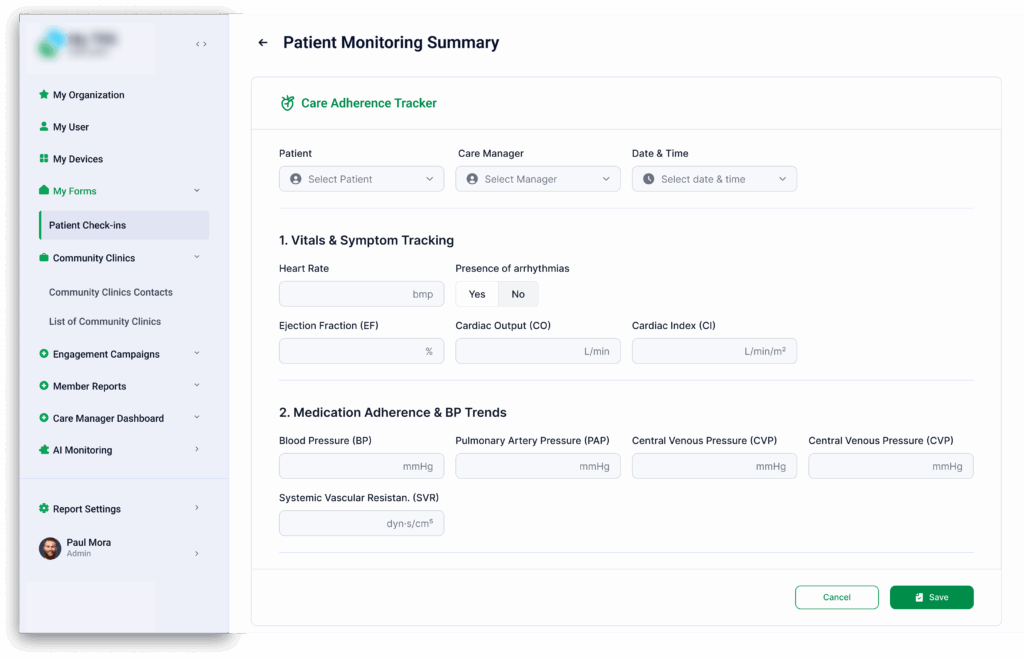
Read about our service: Remote Patient Monitoring Software for Value-Based Care
4. Outcome Measurement and Reporting
Prepare to:
- Define metrics tied to payer contracts
- Track readmissions, adherence, preventive screenings, and cost trends
- Build provider scorecards
- Automate payer reporting and quality submissions
Many organizations choose to outsource healthcare software development for advanced analytics modules, since off-the-shelf tools rarely support customized value-based contracts.
5. Risk and Contract Management
- Analyze shared-risk and capitated payment models
- Assess financial exposure and expected savings
- Plan for accurate patient attribution
- Implement data governance and compliance frameworks
Customized contract-management dashboards built by healthcare software providers can simplify financial modeling and ongoing tracking.
6. Patient Engagement and Experience
Value-based care depends on patient adherence.
Your system should support:
- A patient-friendly mobile app
- Automated reminders and education
- Medication tracking
- Surveys and feedback loops
- Secure messaging
This often requires custom healthcare app development to ensure accessibility, compliance, and integration with EHRs and payer platforms.
7. Organizational Training and Change Management
- Train clinical teams on new workflows
- Align incentives with value-based goals
- Provide continuous feedback through performance dashboards
- Introduce standard operating procedures for coordinated care
8. Technology and Vendor Strategy
Before 2026, organizations should:
- Decide what to build in-house and what to outsource
- Evaluate vendors for domain expertise
- Prioritize partners with deep experience in custom healthcare software development services
- Run pilot programs before scaling
Many healthcare organizations now choose to outsource healthcare software development to accelerate deployment and reduce internal complexity.
How Custom Software Accelerates Value-Based Care
Generic software rarely aligns perfectly with value-based care contract structures. Custom solutions built by an experienced healthcare software development company deliver:
Integrated systems built for interoperability
Custom APIs and connectors unify EHRs, claims data, labs, pharmacy data, remote monitoring devices, and telehealth workflows.
Tailored RPM platforms
Custom features include device management, clinical alerts, triage workflows, patient coaching, and reporting dashboards.
Coordinated care platforms
These support team-based care, messaging, shared care plans, risk scoring, and automated workflows.
Advanced analytics
Dashboards for utilization, cost, risk scoring, contract performance, predictive modeling, and population health insights.
Compliance and security
Custom-built platforms ensure HIPAA compliance, role-based access, audit trails, and encrypted data flows.
This level of precision is not achievable with generic tools, which is why many organizations intentionally outsource healthcare software development to teams that specialize in value-based care.
Why Choose Sigma Software for Healthcare Software Development
Selecting the right technology partner is essential when preparing for value-based care. Our healthcare software development company works with healthcare organisations, payers, insurance companies, and ACOs to build reliable, compliant, and scalable digital tools that support clinical, operational, and financial outcomes.
Discovery Phase
Our work begins with a focused discovery phase. We take time to understand your care model, patient population, workflows, and technology environment. During this stage, we identify where custom healthcare software development solutions can improve coordination, data quality, reporting, or patient engagement. You receive a clear roadmap with timelines, integration needs, and expected outcomes.
Outcome-Based Delivery
Our delivery approach is tied to measurable results. We track improvements in areas such as quality metrics, care coordination speed, reporting accuracy, and patient adherence. This ensures every project — from population health platforms to custom healthcare app development — drives real operational value.
Domain Expertise
Our team has hands-on experience with value-based care models, insurance workflows, and healthcare data standards. This allows us to build solutions that support attribution, risk adjustment, interoperability, and compliance. Unlike general healthcare software providers, we understand the specific challenges payers and ACOs face.
Integration and Scalability
We design systems that integrate smoothly with EHRs, claims platforms, analytics tools, and remote monitoring devices. Whether you want to modernise existing tools or outsource healthcare software development for a new platform, our architecture supports long-term scalability and regulatory change.
Long-Term Partnership
Our support continues after launch. We help your team monitor performance, optimise workflows, and keep the system aligned with new value-based care requirements. This ensures your investment in custom healthcare software development services and custom healthcare app development stays effective and future-ready.
How to Begin Your Transition to Value-Based Care
- Review this checklist with internal stakeholders.
- Define your value-based care goals for 2026.
- Identify technology gaps across data, analytics, workflows, and patient engagement.
- Evaluate whether off-the-shelf solutions are sufficient.
- Consider partnering with a vendor specializing in custom healthcare software development services.
- Start with an MVP or pilot program and scale based on results.
We are ready to help create a roadmap for your organization.
Want to see what this looks like in practice? Let’s talk.
Ready to Solve Your Value-Based Care Challenge?
Let’s talk about your unique workflows and design a custom digital health solution that supports outcome-based care, improves population health, and aligns with value-based reimbursement models.
Whether you’re navigating HEDIS metrics, improving care coordination, or optimizing performance-based contracts, we can help.
Build Your Custom Implementation Plan
Your implementation plan includes integrations, MVP timelines, and long-term support strategies. We build your value-based care solution around real workflows, compliance requirements, and measurable outcome goals.
Launch and Optimize for Outcome-Based Development
Our solutions combine predictive analytics, AI-driven clinical insights, and secure, interoperable data flows. Whether you need compliance tools, shared savings tracking, or a care coordination engine, we align it with your quality metrics, reimbursement goals, and care delivery model.
Ready to Improve Outcomes with Custom Value-Based Solutions?
We design and build custom software for value-based healthcare, built around your data, workflows, and objectives. Whether you need to unify data, support attribution, or track performance across contracts—we’re here to build what works.
Because value-based care requires customized workflows, integrations, and analytics that generic tools cannot provide.
Yes. It reduces hiring burden, accelerates delivery, and ensures access to specialized value-based care expertise.
Healthcare providers, payers, ACOs, insurance companies, and telehealth organizations.
Yes. We specialize in custom healthcare app development for RPM programs, including device integration, clinical alerts, dashboards, and patient apps.
Absolutely. We design systems to grow across populations, states, or contract types.
Custom Software for Aesthetic Clinics: Overcoming Digital Growth Challenges
Solving the 5 Core Data Infrastructure Problems in Diagnostics
3 AI Execution Gaps Slowing Down Medical Distribution
Resolving Fragmented Clinical Data in Biotech
The 7 Core IT Engineering Bottlenecks in Clinical Stage Biotech (And How to Resolve Them)
Where AI Actually Works in Biotech: Clinical Trials, Genomics, and Drug Discovery
Stay in the loop with everything you need to know.