
IoT Healthcare Solution Software Development for Value-Based Care
Healthcare organizations and payers increasingly seek to shift from volume-based to value-based care. Yet the path is complex: it demands continuous patient data, outcome tracking, early intervention, and operational efficiency. An effective tool to support this shift is IoT (Internet of Things). When well-designed and deployed, systems of connected medical devices, sensors, and analytics platforms provide real-time insights that align incentives with outcomes.
This article explains how IoT healthcare solution software development can help healthcare organizations, ACOs, payers, and insurers build robust systems for remote monitoring, care coordination, and population health management. We cover concrete use cases, benefits, challenges, and mitigation approaches, and how partnering with a custom software development vendor can accelerate the transition.
Why IoT Matters for Value-Based Care
Value-based care depends on continuous measurement, early detection, and proactive intervention. Yet many traditional care models rely on episodic visits, limited snapshots, and delayed feedback loops. In contrast, Internet of Things healthcare applications can bridge that gap.
By embedding sensors, wearables, and smart devices into patient care, providers and payers gain visibility into patients’ real-world status between visits. Those data streams enable predictive analytics, care alerts, and insight into adherence patterns. Thus, IoT in healthcare applications can shift care from reactive to preventive.
However, realizing that potential requires thoughtful software design, system integration, data governance, and clinical workflow alignment. This is where an expert IoT platform for healthcare and IoT healthcare applications development plays a critical role.
IoT Use Cases in Value-Based Care
When healthcare leaders decide to shift toward value-based care, they usually look for practical ways to make a real difference — cutting avoidable hospital visits, improving chronic condition management, and keeping patients happier and healthier.
That’s exactly where a well-designed IoT healthcare solution can help. Instead of abstract ideas, these are hands-on, results-driven examples that show how connected technologies actually work in day-to-day care.
Below, you’ll find a series of real-world use cases that bring value-based care to life. Each one explains the core challenge, how connected medical devices and smart systems solve it, what kind of data is worth tracking, and how to measure if the change truly delivers better outcomes — for patients, providers, and payers alike.
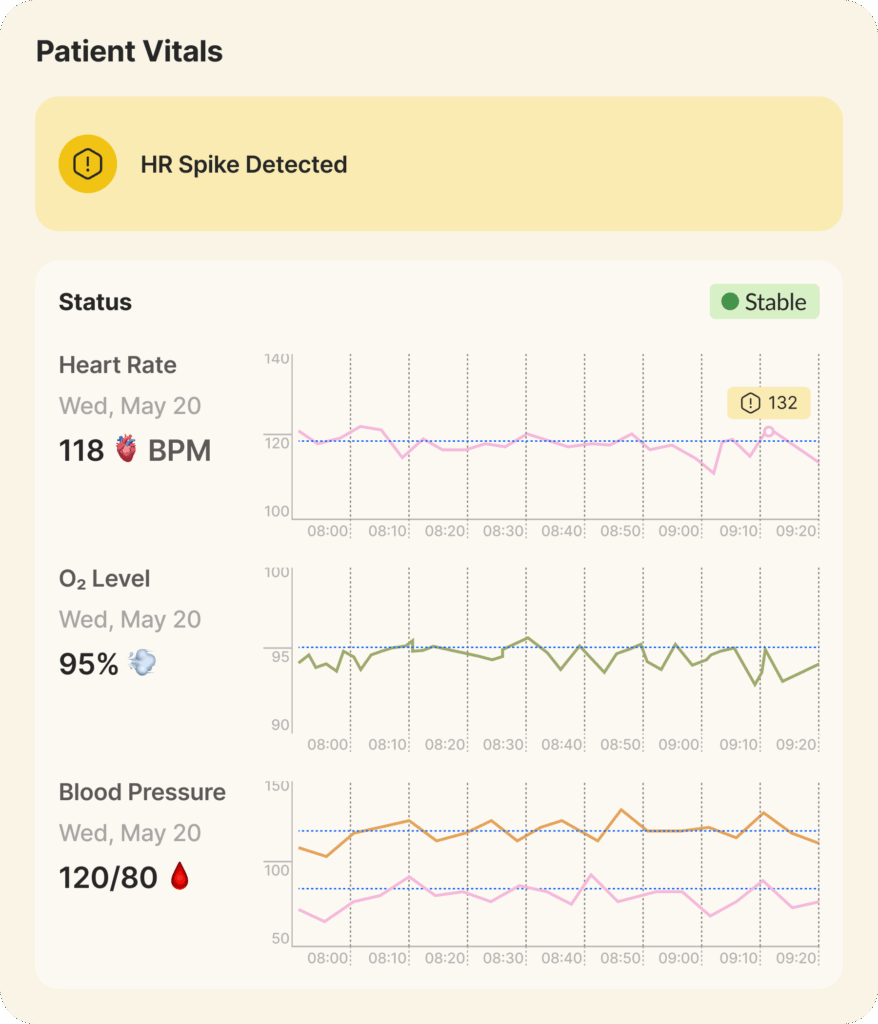
1. Remote Patient Monitoring for chronic disease and post-discharge care
Problem: Patients with heart failure, COPD, diabetes, or recent discharge often deteriorate between visits. This leads to readmissions and high costs.
What IoT does: Use medical connected devices such as blood pressure cuffs, pulse oximeters, weight scales, glucometers, and single-lead ECG patches to capture vitals and trends at home. Devices send measurements to a secure platform where rules and analytics produce prioritized alerts for care teams.
Data to collect: time-stamped vitals, device adherence, activity levels, symptom reports, and short contextual questionnaires.
How to operationalize: integrate device intake with patient onboarding, set individualized thresholds, route alerts to a nurse triage queue, and document follow-up in the EHR.
How to measure success: 30-day readmissions, ED visits, average days in hospital, average time to clinical intervention after alert, and patient engagement rates.
Why it matters: multiple recent studies show measurable reductions in hospitalizations and ED visits after RPM programs, especially in high-risk postdischarge cohorts and heart failure populations.
2. Smart medication adherence and remote medication reconciliation
Problem: Nonadherence causes poor outcomes and avoidable costs.
What IoT does: Use connected medical devices such as smart pill bottles, sensor-enabled blister packs, or dispensers that log dosing events and send reminders to patients or alerts to care teams when doses are missed.
Data to collect: timestamps of openings, missed doses, refill intervals, and reconciliation logs.
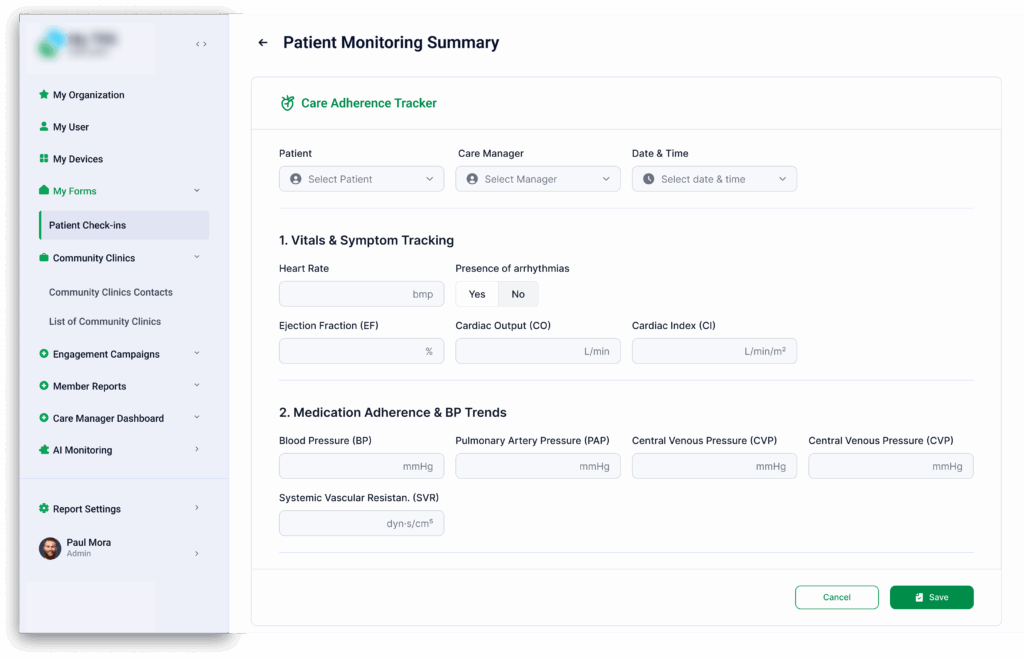
How to operationalize: surface adherence trends in care manager dashboards, trigger pharmacist outreach for pattern breaches, and include adherence data in medication reconciliation at transitions of care.
How to measure success: medication possession ratio, refill timeliness, adherence rate, and downstream changes in disease markers or utilization.
3. Virtual wards and home hospital models
Problem: Hospital capacity is limited, and inpatient stays carry risks.
What IoT does: Create a home-based acute care pathway by combining wearable vitals, continuous monitoring tablets, and nurse video check-ins to safely manage selected inpatients at home.
Data to collect: continuous vitals, nursing notes, medication administration logs, and activity data.
How to operationalize: define eligibility criteria, stage devices before discharge, establish escalation protocols, and use secure messaging for clinical handoffs.
How to measure success: length of stay (in hospital bed days saved), readmissions, patient satisfaction, and cost per episode. Evidence from several health systems suggests virtual ward models can shorten in-hospital stays when applied to the right patients.
4. Predictive monitoring and early-warning systems
Problem: Clinicians must identify deterioration early without being overwhelmed by raw streams of data.
What IoT does: Combines IoT applications in healthcare with analytics to detect trends and predict risk of deterioration. For example, activity reductions and sleep disruption after discharge correlate with higher readmission risk. Feeding these signals into prediction models allows targeted outreach.
Data to collect: trends in vitals, mobility, sleep, and symptom reports.
How to operationalize: run models at the edge or cloud, present risk scores on clinician dashboards, and embed suggested actions aligned to care pathways.
How to measure success: predictive accuracy (AUC), positive predictive value, time saved per avoided adverse event, and reduction in emergency escalations.
5. Ambient sensing to prevent complications and support independent living
Problem: Falls, pressure injuries, and deconditioning drive poor outcomes for older adults.
What IoT does: Use bed sensors, motion detectors, pressure mats, and environmental sensors to detect falls, prolonged immobility, or risky room conditions in both facility and home settings.
Data to collect: motion events, bed exit times, time spent upright, and environmental conditions.
How to operationalize: route high-risk alerts to caregivers, provide daily activity summaries to clinicians, and integrate with home care schedules.
How to measure success: fall rate, pressure ulcer incidence, ability to age in place, and caregiver workload.
6. Asset tracking and operations intelligence
Problem: Lost equipment and inefficient workflows increase cost and slow care.
What IoT does: Track high-value assets and staff location with RTLS tags. Monitor device usage, schedule preventive maintenance, and reduce search time for critical equipment.
Data to collect: location traces, utilization patterns, maintenance logs, and battery status.
How to operationalize: create dashboards for supply chain and clinical leaders; set alerts for equipment shortages; and link asset data to clinical workflows.
How to measure success: asset utilization rates, time saved searching for equipment, rental costs avoided, and ROI on equipment purchases. Studies show meaningful operational savings and safety improvements from RTLS deployments.
7. Cold chain and supply integrity
Problem: Spoilage of temperature-sensitive drugs and vaccines leads to waste and patient safety risk.
What IoT does: Use continuous temperature and humidity logging with real-time alerts across storage and transport.
Data to collect: time-series environmental data and transit logs.
How to operationalize: trigger quarantine workflows on excursion, generate compliance reports, and analyze patterns to improve logistics.
How to measure success: spoilage incidents avoided, compliance rate, and cost savings.
7 Benefits of IoT in Healthcare & Value-Based Care
A well-designed IoT healthcare solution does more than collect patient data — it helps care teams act faster, coordinate better, and focus on outcomes that truly matter. With an IoT platform for healthcare, providers can detect issues early, manage chronic conditions more efficiently, and keep patients engaged between visits.
For payers and ACOs, IoT solutions for healthcare deliver valuable insights that make it easier to measure results and align incentives. In the following section, we’ll explore the most practical benefits of Internet of Things in healthcare, showing how connected care supports better outcomes, lower costs, and smoother operations across your organization.
1. Better clinical outcomes through continuous, contextual data
Because IoT healthcare applications collect repeated measurements over time, they reveal trends that single, episodic measurements miss. Consequently, care teams catch deterioration sooner and intervene earlier. For executives, this translates to fewer avoidable admissions and lower episode costs. Systematic reviews of remote monitoring show average reductions in hospitalization and modest improvements in mortality in some cohorts. To prove this, track changes in readmission rates, disease-specific control metrics, and acute care days per 1000 members.
2. Reduced utilization and demonstrable cost savings
By enabling outpatient management where appropriate, IoT solutions for healthcare reduce emergency department visits and inpatient days. For value-based contracts, even small percentage reductions in utilization can convert into substantial shared savings. Use ROI models that include device cost, staffing for monitoring, avoided bed days, and changes in readmission penalties to make your business case. Recent cohort studies demonstrate significant drops in hospitalizations for high-risk groups under RPM programs.
3. Improved patient experience and retention
Patients report feeling safer and more connected when monitored at home. As a result, patient satisfaction and net promoter scores tend to improve. For payers and ACOs, improved satisfaction often supports retention, smoother transitions, and easier enrollment in chronic care programs.
4. Scalable chronic disease management and risk stratification
IoT enables stratifying populations at scale by using device data to identify rising risk. That reduces reliance on high-cost, high-touch case management for everyone and focuses resources where they yield the greatest marginal benefit. Track per-member per-month cost, high-risk cohort size, and average cost per risk tier.
5. Operational efficiency and supply chain control
Connected medical devices and asset tracking shrink operational waste and speed up care delivery. Because assets are found faster and maintained proactively, staff spend more time on patient care. Measure asset turnover, mean time to find, rental spend, and maintenance backlog to quantify gains.
6. Stronger contract positioning and payer partnerships
When an organization can show data-driven reductions in utilization and improvements in outcomes, it strengthens negotiating power with payers. IoT programs that deliver consistent metrics can be the foundation for shared savings contracts, bundled payments, or risk adjustments.
7. Actionable population insights for continuous improvement
Aggregated device data feed population analytics. For example, adherence signals combined with social determinant overlays can reveal where community interventions deliver the best return. Use cohort analyses, trend reports, and A/B pilots to convert insights into optimized care pathways.
Challenges in IoT for Healthcare & How to Address Them
Of course, bringing Internet of Things healthcare applications to life isn’t always smooth sailing. There are real challenges — from data security and interoperability to device management and patient adoption.
The good news? Most of these hurdles can be handled with thoughtful design, the right technology foundation, and a partner who understands both healthcare workflows and software engineering.
In the next section, we take an honest look at what typically goes wrong when implementing Internet of Things healthcare applications, and more importantly, how each of those challenges can be turned into a manageable, long-term success with proper planning and collaboration.
1. Data Security, Privacy, and Regulatory Compliance
Challenge: Medical IoT devices expand the attack surface. Each device may be a vector for data breaches or device manipulation. Compliance with HIPAA, GDPR, and other regulations is complex.
Mitigation:
- Use end-to-end encryption, secure boot, device authentication, and hardware root-of-trust.
- Isolate medical IoT networks from general IT networks (network segmentation).
- Deploy continuous monitoring and intrusion detection specifically for IoT devices.
- Engage compliance audits and embed privacy-by-design and security-by-design principles early.
2. Interoperability and Integration with Legacy Systems
Challenge: IoT devices and platforms often must connect to existing EHRs, claims systems, analytics stacks, and clinical workflows. Disparate data formats, protocols, and interfaces complicate this.
Mitigation:
- Use open standards (e.g., HL7 FHIR, IEEE 11073, LOINC) and design robust APIs.
- Employ a modular, layered architecture that isolates hardware, data ingestion, business logic, and presentation.
- Build middleware or data orchestration layers that normalize and standardize data from heterogeneous devices.
- Use abstraction so new device types can be incorporated with minimal friction.
3. Device Management at Scale & Lifecycle
Challenge: Managing hundreds or thousands of devices means provisioning, firmware updates, monitoring, version control, and decommissioning become operationally complex.
Mitigation:
- Implement over-the-air (OTA) update mechanisms with rollback support.
- Build a device management platform with dashboards for health, connectivity, battery state, and alerts.
- Automate onboarding and registration workflows.
- Plan device replacement cycles and support redundancy to avoid single-point failures.
4. Connectivity, Reliability, and Latency
Challenge: Real-time or near-real-time data flows can be impacted by network outages, bandwidth limits, or dead zones (especially in rural environments).
Mitigation:
- Support multiple connectivity options (WiFi, cellular, LPWAN, NB-IoT, LoRaWAN) and fallback paths.
- Use local edge processing (fog or gateway computing) to buffer and pre-process data in case of connectivity loss.
- Design robust retry, queuing, and data reconciliation logic.
- Monitor network health and optimize for latency where needed (e.g., alarms).
5. Data Overload & Clinical Workflow Burden
Challenge: Clinicians may be overwhelmed by continuous streams of sensor data. Without intelligent filtering or triage, signals get lost, false alarms proliferate, and burnout grows.
Mitigation:
- Embed rules engines, thresholds, and prioritized alerts to triage only relevant events.
- Use analytics and machine learning to detect trends and anomalies rather than raw streaming.
- Assign roles (e.g. nurse triage, care manager dashboards) to moderate clinician load.
- Integrate IoT alerts into existing clinical workflow tools (EHR inbox, care management UI).
6. Patient Adoption, Digital Literacy, and Behavior Change
Challenge: Especially with older or less tech-savvy patients, using wearables or home sensors regularly can be a barrier.
Mitigation:
- Provide onboarding, training, and ongoing support (help lines, video guides).
- Use user-friendly, plug-and-play devices with minimal user intervention.
- Incorporate motivational nudges, gamification, and feedback loops.
- Monitor adherence and intervene proactively when usage drops.
7. Reimbursement and Business Model Alignment
Challenge: In many regions, reimbursement for remote monitoring or IoT-enabled care is insufficient or inconsistent. Some practices struggle with financial incentives.
Mitigation:
- Participate in payer pilots, grants, or value-based contracts that reward outcomes rather than volume.
- Demonstrate ROI via pilot studies (reduced readmissions, cost savings, risk stratification).
- Use bundled payments or shared savings models to align incentives across stakeholders.
- Provide analytics and reporting to support negotiations and business case development.
8. Evidence Base, Clinical Validation, and Risk Management
Challenge: While IoT-based remote monitoring shows promise, the evidence is stronger in select groups than across all conditions. Some systematic reviews caution that for many patient groups, evidence is limited.
Mitigation:
- Start with pilot populations where evidence is strongest (e.g. heart failure, COPD, hypertension) and expand gradually.
- Collect your own outcomes data—structure deployments to feed prospective evaluations.
- Monitor safety, false positives, and user complaints.
- Engage clinicians in evaluation and iteratively refine alert logic.
Why Choose Sigma Software as Your IoT Software Vendor for Value-Based Care
Below is the case for selecting a partner for IoT healthcare solution software development. Focusing on the practical capabilities you need, how we structure engagements, and how we guarantee outcome orientation.
1. Discovery phase: practical, evidence-driven planning
Before writing any code, we lead a thorough discovery that reduces risk and speeds time to impact. During discovery, we:
- Define the clinical problem and target cohort, for example, 30-day post-discharge heart failure patients with high readmission risk.
- Map current workflows across clinicians, care managers, and IT.
- Identify measurable outcomes tied to your value contract.
- Evaluate device choices against accuracy, regulatory status, connectivity, and user burden.
- Build a pilot design with clear success criteria, timelines, and a cost model.
Because discovery produces a quantifiable pilot plan, stakeholders gain clarity, and the business case is evidence-based rather than hopeful.
2. Deep domain expertise: clinical and payer fluency
We do not treat healthcare as a generic vertical. Our teams include clinical informaticists, population health managers, and engineers who have worked on EHR integrations, claims analytics, and compliance. Therefore:
- We understand clinical workflows and will not force clinicians into new burdensome processes.
- We design data flows that align with quality metrics and payer reporting.
- We translate contract incentives into concrete system behavior, such as alerting thresholds tied to readmission penalties.
In short, you do not get only coders. You get people who know how care is delivered and paid for.
3. Outcome-based development and delivery
We focus on results, not features. Concretely, that means:
- We set measurable success metrics at the start (for example, a 10 percent reduction in readmissions for the pilot cohort).
- We adopt a pilot-to-scale delivery: rapid prototype, clinical validation, then controlled scale.
- We instrument everything for evaluation: event logs, adherence metrics, time-to-intervention, and financial metrics.
- We run iterative cycles that tie product changes directly to outcome improvements.
Consequently, you can see whether the investment produces the agreed clinical and financial results before scaling.
4. End-to-end technical capability
We cover the full stack that an IoT platform for healthcare projects requires:
- Device integration and firmware consulting.
- Secure device provisioning and OTA updates.
- Edge gateway software for latency and resilience.
- Cloud ingestion, normalization, and a standards-based API layer (FHIR support).
- Analytics pipelines and clinician/care manager dashboards.
- Mobile apps for patients with simple onboarding flows.
Because we handle the entire pipeline, you avoid integration gaps and hidden costs.
5. Security, privacy, and compliance baked in
Security is not an afterthought. We implement:
- Device authentication and hardware root of trust, where available.
- End-to-end encryption in transit and at rest.
- Fine-grained access control and audit logging.
- Privacy-by-design and support for consent management and data minimization.
These controls help you meet HIPAA, GDPR, and relevant national regulations.
6. Interoperability and integration with legacy systems
We build to interface cleanly with EHRs and claims systems via standard protocols. That reduces clinician friction and supports reporting needs for payers. In practice, we normalize device data, map to clinical vocabularies, and deliver packaged integrations.
7. Operations and device lifecycle support
We do not hand over the system and disappear. Our delivery includes:
- Device management panels for provisioning, health, and firmware rollout.
- Operational playbooks for triage, alert handling, and patient support.
- SLA-backed monitoring and 24/7 incident response options.
8. Evidence generation and ROI support
We help you measure and document impact. That includes study design for pilots, dashboards for stakeholders, and materials you can use in payer negotiations. When possible, we align evaluation with published evidence and local outcomes so you can demonstrate real value. Recent studies and systematic reviews show RPM and IoT programs can reduce hospitalizations in appropriate cohorts. We use that evidence to calibrate expectations and design trials.
Final thoughts
For healthcare organizations, ACOs, payers, and insurers aiming to move toward value-based care, IoT healthcare solution software development offers a powerful lever. Through IoT healthcare applications, you can monitor patients continuously, intervene early, reduce unnecessary hospital use, streamline operations, and generate population-level insights.
Yet success depends on sound system design, interoperability, privacy, workflow alignment, and a phased rollout strategy. By choosing a vendor that understands both the clinical and technical dimensions as we do, you can turn the promise of IoT into a tangible impact in your care models.
If you are considering IoT-enabled care programs or want to explore how a tailored IoT platform for healthcare might fit into your value-based care roadmap, we’d be glad to discuss next steps.
Want to see what this looks like in practice? Let’s talk.
Ready to Solve Your Value-Based Care Challenge?
Let’s talk about your unique workflows and design a custom digital health solution that supports outcome-based care, improves population health, and aligns with value-based reimbursement models.
Whether you’re navigating HEDIS metrics, improving care coordination, or optimizing performance-based contracts, we can help.
Build Your Custom Implementation Plan
Your implementation plan includes integrations, MVP timelines, and long-term support strategies. We build your value-based care solution around real workflows, compliance requirements, and measurable outcome goals.
Launch and Optimize for Outcome-Based Development
Our solutions combine predictive analytics, AI-driven clinical insights, and secure, interoperable data flows. Whether you need compliance tools, shared savings tracking, or a care coordination engine, we align it with your quality metrics, reimbursement goals, and care delivery model.
Ready to Improve Outcomes with Custom Value-Based Solutions?
We design and build custom software for value-based healthcare, built around your data, workflows, and objectives. Whether you need to unify data, support attribution, or track performance across contracts—we’re here to build what works.
Custom Software for Aesthetic Clinics: Overcoming Digital Growth Challenges
Solving the 5 Core Data Infrastructure Problems in Diagnostics
3 AI Execution Gaps Slowing Down Medical Distribution
Resolving Fragmented Clinical Data in Biotech
The 7 Core IT Engineering Bottlenecks in Clinical Stage Biotech (And How to Resolve Them)
Where AI Actually Works in Biotech: Clinical Trials, Genomics, and Drug Discovery
Stay in the loop with everything you need to know.